
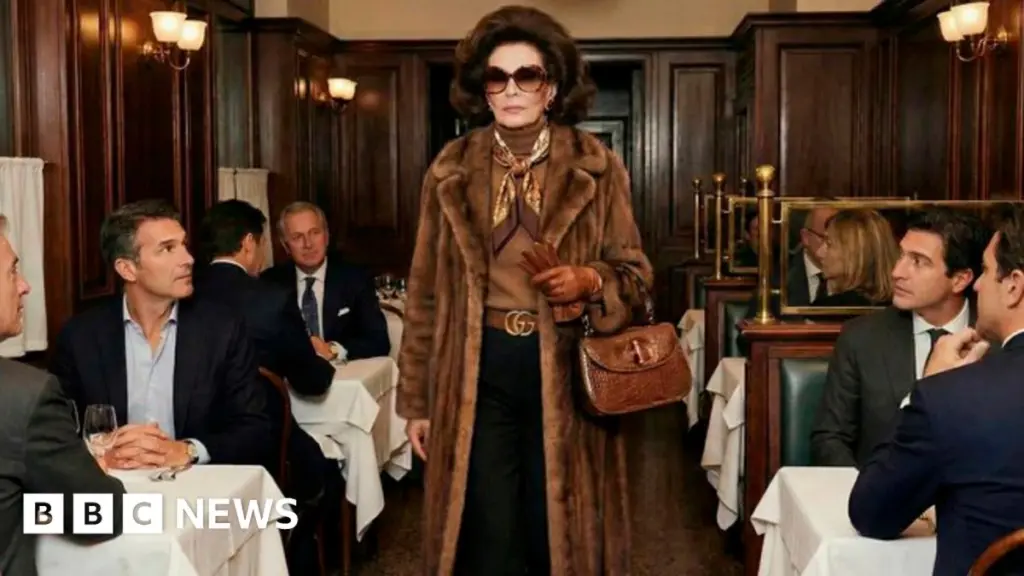
Gucci is currently facing significant public backlash. This comes after the luxury fashion house employed artificial intelligence to create promotional images for its upcoming show at Milan Fashion Week. The controversy centers on the use of AI-generated visuals, which have been shared across social media platforms.
A number of users have voiced their concerns, questioning how the adoption of AI, over human models and photographers, aligns with Gucci’s stated values. The brand has frequently highlighted its commitment to “creativity and Italian craftsmanship.” This dichotomy has fueled the debate among consumers and industry observers.
One particularly sharp critique emerged in response to an AI-generated depiction of an elegant, older Italian woman. She was shown wearing a classic Gucci ensemble, prompting a commenter to lament, “Bleak days when Gucci can’t find a real human Milanese grandmother to wear an outfit from 1976.” The BBC has reached out to Gucci and its parent company, Kering, for official comment on the matter.
While the images are accompanied by clear labeling as “created with AI,” critics argue they exemplify what has been termed “AI slop.” This descriptive phrase refers to the growing volume of often low-quality, AI-generated content saturating social media feeds. Furthermore, questions have been raised regarding the necessity for a high-fashion brand to utilize this cost-saving technology for its marketing campaigns.
Context of Gucci’s AI Usage
This development occurs as Alessandro Michele, Gucci’s creative director, prepares to unveil his latest vision on the runway in Milan this Friday. While this particular campaign has sparked controversy, it represents an ongoing exploration of technology within the brand’s marketing strategy.
Gucci has previously engaged with digital artists to produce unique visuals. This engagement has included AI-generated imagery that was subsequently auctioned as non-fungible tokens (NFTs) by Christie’s. In a notable instance in December, the brand released an AI-generated video. The video depicted a model walking a runway, with photographers behind her comically falling over themselves in a bid to capture her image.
The trend of integrating generative AI tools into social media content and advertising is not unique to Gucci. Several other designer and high-street brands, including Valentino and H&M, have also experimented with this technology, often presenting it as a creative endeavor.
Expert and User Perspectives
Dr. Priscilla Chan, a senior lecturer at Manchester Metropolitan University’s Fashion Institute, highlighted the potential risks for companies embracing new technologies in their marketing efforts. She noted that while some past innovations had generated significant positive publicity, AI carries the distinct risk of provoking substantial negative public reaction instead.
“I think particularly luxury fashion brands need to pay attention [to whether] the latest technology can create positive image for their brands,” Dr. Chan stated, emphasizing the importance of careful consideration for brands operating in the luxury sector.
However, not all reactions on social media have been critical. Some users have expressed the view that Gucci successfully captured the essence of “Milano glam” without sacrificing the brand’s core identity. Tati Bruening, a photographer well-known on TikTok as illumitati, shared her perspective.
Bruening stated she is “generally not a fan” of fashion houses employing AI. However, she acknowledged that there can be limited, appropriate applications for the technology. “There are ways to use AI that is non-invasive to the creative ecosystem and I see no problem with that,” she commented. Such acceptable uses, for Bruening, could include tasks like image retouching, minor edits, or the creation of mood boards. She differentiated this from full image generation, asserting, “There is a difference between enhancing or editing simple things with AI vs. image generation.”
Adding another layer to the discourse, Bruening suggested that Gucci might have intentionally used these images to provoke a discussion about the nature of high fashion in the current AI era. She posited that the campaign could be interpreted as a form of parody. “I don’t feel that this campaign was necessarily made to reflect luxury but create commentary on what luxury actually is,” she concluded.