
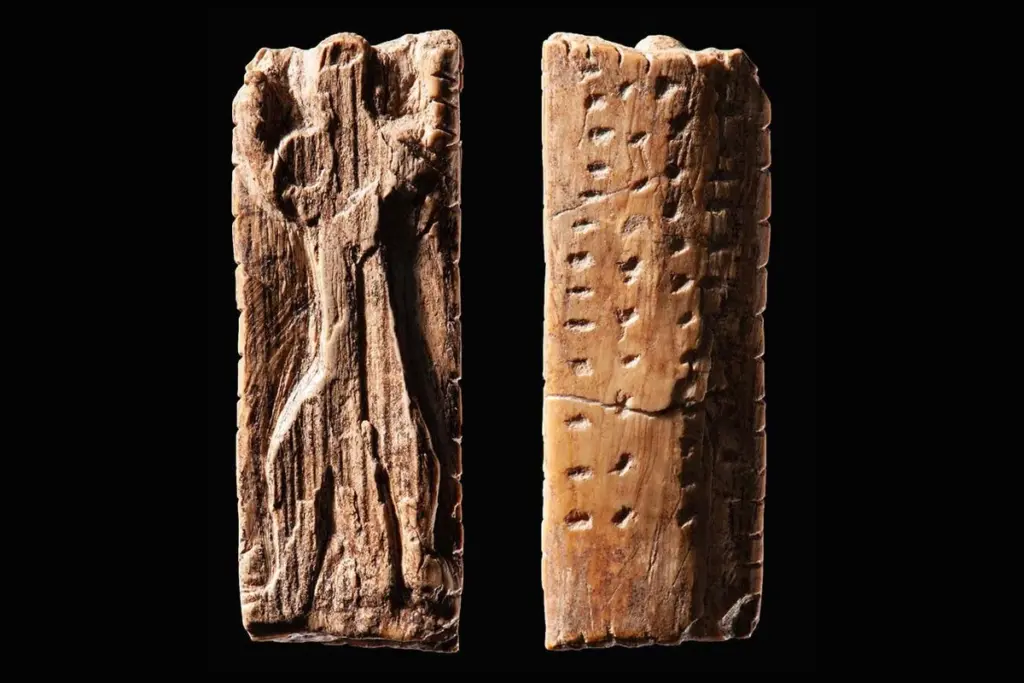
Evidence suggests that Stone Age inhabitants of Europe, as far back as 40,000 years ago, employed a form of symbolic notation comparable in sophistication to the earliest known writing systems, such as cuneiform. This discovery, stemming from an analysis of enigmatic signs etched onto artifacts found in Germany, could potentially shift the timeline for the emergence of proto-writing by over 30,000 years.
The practice of making deliberate marks on objects is a long-standing human behavior. However, early groups of Homo sapiens who migrated to Europe approximately 45,000 years ago elevated this practice to a more complex level. Numerous artifacts, including pendants, tools, and figurines crafted by these groups, were found to be engraved with sequences of distinct graphic symbols, such as lines, crosses, and dots. These early Europeans also applied symbols to cave walls, often alongside animal depictions, though the precise meaning of these markings has long been a subject of debate.
The systematic use of symbol sequences is particularly noteworthy. Archaeologist Ewa Dutkiewicz, from the Museum of Prehistory and Early History in Berlin, Germany, highlights this aspect: “Having this recurring, very systematic use of clearly applied marks distinct from each other, put into sequences – that’s completely something different.”
The central challenge lies in deciphering the meaning, if any, of these symbols. Without an interpretative key akin to the Rosetta Stone, which aided in understanding Egyptian hieroglyphics, definitive comprehension remains elusive. Nevertheless, valuable insights can be gained through careful analysis of how these signs were utilized.
To explore this, Dutkiewicz and linguist Christian Bentz of Saarland University in Saarbrücken, Germany, examined sequences of signs engraved on a significant collection of artifacts. These items were recovered from caves in the Swabian Jura region of southwestern Germany and date to the Aurignacian period, spanning from about 43,000 to 34,000 years ago. This era predates contemporary European cultures and was occupied by some of the earliest H. sapiens to arrive on the continent. Among these artifacts, which include musical instruments like flutes, carvings of animals such as mammoths, and representations of human-animal hybrids, a substantial number—260 items—bear over 3,000 engravings of 22 different symbols. The V-shaped notch appears most frequently, followed by lines, crosses, and dots, with symbols like Y-shapes and star-like forms used less often.
The researchers employed computational models to assess the complexity and information density within these sequences. Their analysis involved comparing these patterns to those found in proto-cuneiform, an early form of proto-writing discovered on clay tablets from Mesopotamia dating back to approximately 3500 to 3350 BC, as well as to modern written systems. The objective was to identify commonalities between the Stone Age symbolic systems and later methods of recording information.
“It makes sense to look at sequences, because information is not only encoded in the number of different signs you have, but… in how you combine the signs,” explains Bentz. He notes that the English alphabet, for example, has only 26 letters, but their arrangement allows for the encoding of all spoken language sounds.
The analysis revealed that Aurignacian symbol sequences differed distinctly from modern writing. However, to the researchers’ surprise, the statistical characteristics of the 40,000-year-old sequences showed a strong resemblance to those of the earliest proto-cuneiform clay tablets. Bentz states, “The features are very, very similar.”
This similarity implies that the earliest H. sapiens in Europe, who were primarily hunter-gatherers, had developed a system for recording certain thoughts through symbols. This aligns with a fundamental definition of writing: a system that facilitates human communication via a conventional set of visible marks.
Palaeoanthropologist Genevieve von Petzinger comments on the findings: “What this study shows is that the way that the marks are being used on the Aurignacian pieces has a type of configuration that closely matches proto-cuneiform.” She emphasizes that these findings demonstrate “pattern repetition and organization.” However, she cautions that this does not equate to the information recorded in both systems having identical meanings.
While cuneiform is understood to have originated as a system for recording economic transactions, such as crop yields, the specific meanings of the Stone Age “writing” remain uncertain. Some potential interpretations suggest the marks might have served as a form of calendar. Dutkiewicz points to the Adorant, a depiction of a lion-human figure carved on mammoth ivory. This artifact is marked with dots and notches arranged in rows of 13 or 12, which could represent “calendric observations.” She suggests, “It makes sense that these people might want to keep track of time.”
Dutkiewicz and Bentz also investigated whether specific signs were associated with different types of objects, uncovering notable patterns. For instance, crosses, despite their frequency, never appeared on objects depicting humans. Instead, they were commonly found on artifacts featuring animal carvings, particularly horses and mammoths, as well as on tools. Conversely, dots were absent from tools.
“Whatever this means, we cannot say,” Dutkiewicz admits. “But it’s a firm pattern which tells us there is a deliberate choice of signs that were applied on the media.” Furthermore, these established patterns remained consistent over the 10,000-year span of artifact creation, indicating that these conventions were passed down through generations. “It’s something that has been carried on over millennia,” she notes.
“These were definitely marks being made in specific locations for specific reasons,” adds von Petzinger. “Even if we don’t know what the marks meant, we know they had meaning to the people who made them.”
This research builds upon earlier work from 2023. That study proposed that sequences of dots, lines, and the symbol Y, found alongside animal imagery in cave art dating back as much as 20,000 years, constituted a code used to record the habits of prey animals.
Collectively, these studies indicate that while the first complete writing system, cuneiform, emerged around 3200 BC, its conceptual antecedents may extend as far back as 40,000 years ago.