
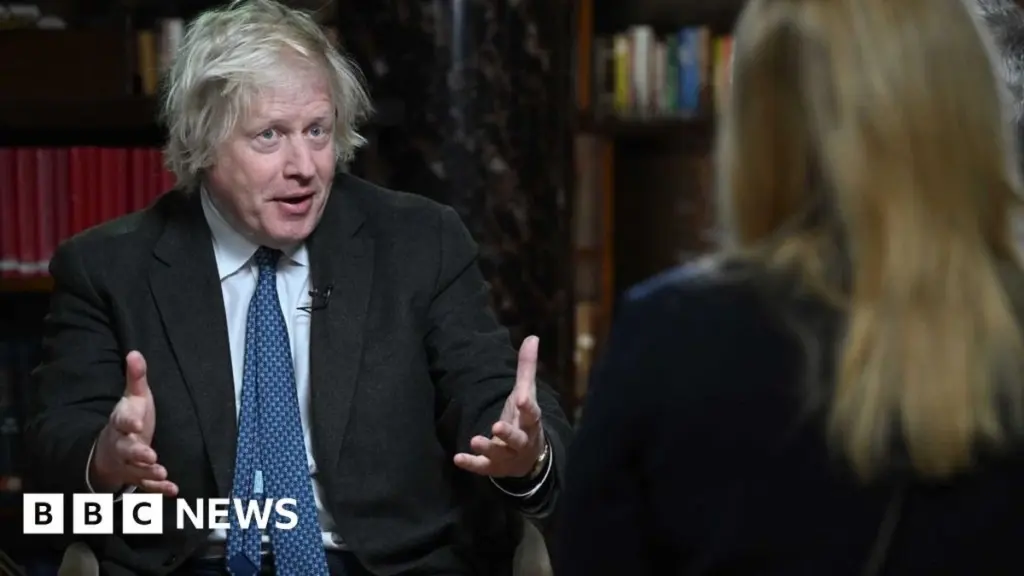
Former Prime Minister Boris Johnson has urged the United Kingdom and its allies to immediately deploy non-combat troops to Ukraine. Speaking in an exclusive interview, Johnson stated that such a move could “flip a switch” in Russian President Vladimir Putin’s perception of the conflict.
Proposed Deployment and Rationale
Johnson, alongside former head of the military Adm Sir Tony Radakin, suggested that troops could be stationed in peaceful, non-fighting roles within Ukraine. He questioned the delay in such a deployment, stating, “If we can have a plan for boots on the ground after the war, after Putin has condescended to have a ceasefire, then why not do it now?” This proposal comes as the UK government is reportedly exploring a “coalition of the willing” with allies to provide forces for peace and stability, contingent on a ceasefire agreement.
Reflection on Past Decisions
Speaking just days before the fourth anniversary of the war, Johnson, who led the UK at the time of the invasion, reflected on how the conflict might have been averted. He suggested that Western allies had not paid sufficient attention to Putin’s escalating aggression, referencing the 2014 annexation of Crimea.
Johnson and Sir Tony recalled the initial moments of the Russian invasion on February 24, 2022, and the early decisions made to support President Volodymyr Zelensky. Despite substantial UK assistance, both acknowledged that Western allies had been notably slow and overly cautious in providing necessary support.
Critique of Allied Response: “Incrementalism”
For years, allies frequently took months to approve the provision of requested weaponry. Sir Tony characterized this approach as “incrementalism,” noting that Ukraine perceived it as excessively slow and deeply frustrating, a tension that has persisted throughout the war.
Johnson contended that this caution had resulted in lives lost. “We’ve always delayed needlessly,” he remarked. He observed that when Western nations eventually supplied what Ukraine requested, it consistently benefited Ukraine and undermined Putin’s objectives. “I mean, the one person who suffers from escalation is Putin,” Johnson added.
Clarification on Troop Roles
Addressing the nature of the proposed troop deployment, Johnson clarified that these individuals would not be in a war-fighting capacity. He elaborated on the potential impact of a non-combat deployment, asking, “If we can have boots on the ground after the war, after Putin has condescended to have a ceasefire, then why not do it now?” He emphasized that the decision and initiative would remain with the Ukrainians.
When questioned about sending allied forces to safe areas in Ukraine to create a strategic impact, Johnson affirmed, “Yes, I think, you know, if we are willing to do it in the context of a ceasefire, which of course puts all the initiative, all the power in Putin’s hands, why not do it now?” He stated there was no logical reason to withhold sending peaceful ground forces to demonstrate constitutional support for a free, independent Ukraine.
“That is a political thing,” Johnson explained. “It’s about whether Ukraine is a free country or not. If it’s a vassal state of Russia, which is what Putin wants, then obviously it’s up to Putin to decide who comes to his country. If it’s not, then it’s up to the Ukrainians.”
Potential Russian Reaction
The presence of international troops, regardless of their mission, would likely be viewed by Putin as a significant provocation. Following the announcement of a proposed “reassurance force” in September of the previous year, Putin had stated that any troops deployed to Ukraine would be considered “legitimate targets.”
Failures in Addressing Putin’s Aggression
Johnson described the failure to confront Putin over the 2014 annexation of Crimea, during David Cameron’s premiership, as “tragic.” When asked if the UK and its Western allies had inadvertently enabled Putin’s invasion by not taking his aggression seriously, Johnson agreed. He cited Putin’s emboldenment from a perceived Western failure in Syria to punish Assad for chemical weapon use.
Further emboldenment, according to Johnson, came in February 2022 from the situation in Afghanistan, specifically the withdrawal of American and UK forces. He suggested this created a widespread impression that the West was on the defensive, with the images of Americans fleeing Afghanistan significantly encouraging Putin.
“The general ambiguity of the Western position” had, in Johnson’s view, harmed Ukraine. He added that had there been “clarity and simplicity about Ukraine, rather than endless fudge and obscurity, we could have saved that, we could have prevented that invasion.”
Regret and Lack of Resolve
Johnson, who served as foreign secretary and prime minister during parts of this period, expressed regret for not taking more decisive action. “I do think we should have done more,” he stated. He identified the core problem in the Ukraine conflict as Putin’s ongoing disbelief that the West considers a free and independent Ukraine an overwhelming strategic objective. He warned that until this determination is evident to Putin, he will likely persist with his current course, attributing this to a “fundamental lack of resolve.”
Defence Spending Commitments
On the subject of defence spending, Sir Tony urged the government to fulfill its commitment to allocate 3.5% of national income to defence by 2035, a pledge made at the NATO summit the previous year. He highlighted the international commitment made by the Prime Minister, emphasizing that it was necessitated by the ongoing war in Europe and Russia’s dangerous, albeit currently weak, position.
“We are safe as a country at the moment: we are a nuclear power, we’re a member of Nato, we have America as our principal ally,” Sir Tony noted. However, he stressed the necessity of investing in these areas to ensure national security through the 2030s. He pointed to the defence review and NATO’s mobilization around an operational plan and increased spending needs, concluding that these commitments “has to be resolved.” He questioned, “Where is our plan?”
Analysis: A Decade of Foreign Policy Missteps
As the war in Ukraine nears its grim anniversary, Boris Johnson’s admission that the conflict could have been prevented, attributing it to Western failures during his own tenure, stands out. His assertion suggests that nearly a decade of foreign policy missteps may have paved the way for the current situation. This claim is likely to be debated extensively for years to come.
Johnson’s proposal to send UK and allied troops to Ukraine goes beyond current suggestions from the UK or its partners. This initiative was hinted at by Sir Keir Starmer as a potential “coalition of the willing” nearly a year ago. Adm Sir Tony Radakin, who was present with Johnson, was involved in preparing forces for potential support of Ukraine, conditional on a peace deal.
In 2022, European nations pledged support but explicitly ruled out sending troops. Shifting the focus of a “coalition of the willing” to troop deployment now would represent a highly significant political maneuver. However, allies might also explore alternatives, such as establishing safe zones in western Ukraine or reopening Lviv airport as preliminary steps toward a ceasefire.
Johnson’s suggestion appears to stem from personal frustration, amplified by his continued engagement with Ukraine, regarding the hesitant allied response. The support provided has been sufficient for Ukraine to continue fighting but insufficient, in his view, to compel an end to the war.
Both Johnson and Radakin underscored their belief that President Zelensky has already made concessions. They argued that intensifying economic and military pressure on the Kremlin is the only path to peace. Johnson conveyed to the White House his view that the Russian leader does not genuinely desire peace. However, with ongoing loss of life, the extent to which Western allies are willing to escalate their actions, and Putin’s readiness to engage, remains uncertain.