
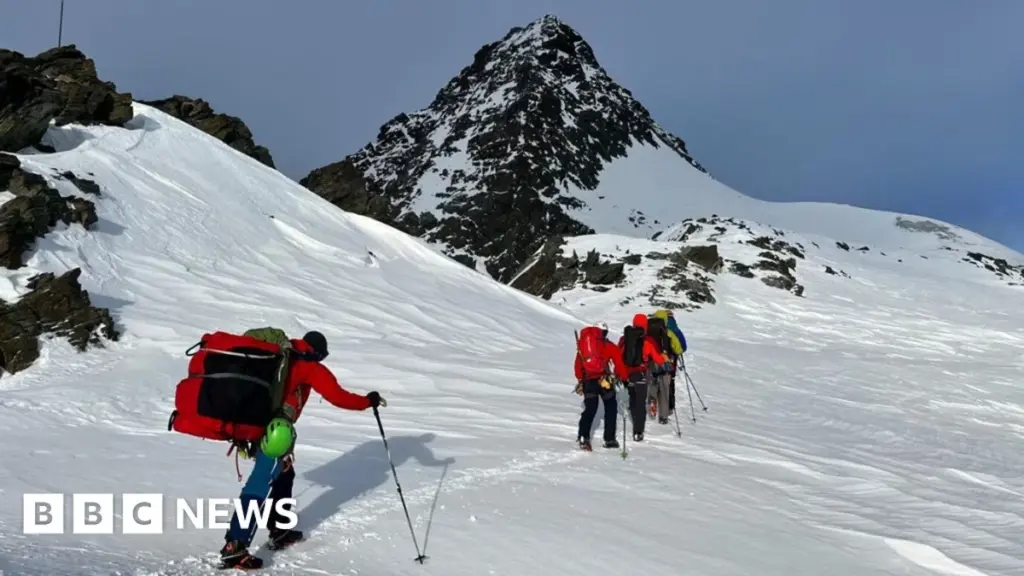
An Austrian man has been found guilty of gross negligent manslaughter following the tragic freezing death of his girlfriend on Austria’s highest peak last year. Thomas P, whose full name is withheld due to Austrian privacy laws, received a five-month suspended sentence and was fined €9,600 (£8,400).
Kerstin G. succumbed to hypothermia during a climbing expedition on the Grossglockner mountain in January 2025. In a statement relayed to the BBC, the court cited Thomas P.’s unblemished prior record and the profound personal loss he suffered as mitigating factors in its decision. The court also acknowledged the impact of public discussion on social media, which it stated had been incriminating for the defendant.
Climbing Experience and Circumstances
Judge Norbert Hofer, himself an experienced climber involved with mountain and helicopter rescue operations in Tyrol, characterized Thomas P. as an exceptional alpinist. However, he noted a significant disparity in climbing proficiency between Thomas P. and his girlfriend, stating Kerstin G. was considerably less experienced. The judge emphasized that the couple should have aborted their ascent given Kerstin G.’s insufficient experience in winter conditions.
The court also heard testimony from Andrea B., a former girlfriend of Thomas P. She recounted an incident from a 2023 Grossglockner tour where he allegedly left her alone. She described feeling disoriented, experiencing a power failure with her headlamp, and being in distress, crying and screaming, when he suddenly moved ahead, abandoning her.
Discovery of the Victim
Reports from Austrian media detailed the distressing discovery of Kerstin G.’s body by a mountain rescue team. She was reportedly found hanging upside down from a rock face, still wearing her rucksack. A rescuer testified that her head was tilted back, her eyes wide open. She was not wearing gloves, and her boots were unfastened. The rescuer expressed astonishment at her position, adding that stronger winds could have caused her to fall down the south face.
The prosecution highlighted the severe weather conditions, with strong winds reaching up to 74 km/h (45 mph) and temperatures at -8°C, with a windchill of -20°C. It was argued that, as the more experienced climber, Thomas P. bore the responsibility for guiding the expedition. Prosecutors asserted he failed to turn back or summon assistance promptly for his girlfriend.
The prosecutor maintained that Thomas P. should not have allowed the situation to escalate. Thomas P. pleaded not guilty, expressing deep remorse and stating his love for his girlfriend, describing her as athletic and their trip as jointly planned.
Defense and Disputed Timeline
Thomas P.’s lawyer, Kurt Jelinik, characterized the situation as extremely difficult and stressful for the couple. He contended that Kerstin G. was not inexperienced and understood the risks involved. Prosecutors presented that the couple became stranded, and Thomas P. failed to contact the police or send distress signals despite a police helicopter flying overhead around 10:30 PM. Video footage from the helicopter appeared to show the couple still climbing, and the judge noted the absence of distress calls.
The defense countered that at that stage, Thomas P. and Kerstin G. felt well and did not request help because they believed they were close to the summit. Webcam footage documented their torchlights as they ascended. Shortly thereafter, the defense stated, the situation deteriorated rapidly as Kerstin became exhausted near the summit. She reportedly asked Thomas P. to seek help.
At 00:35 on January 19th, he contacted mountain police. The specifics of this conversation are contested. While rescuers claimed it was not an emergency call, the lawyer stated Thomas P. denied reporting that everything was fine. He proceeded to the summit and descended via the other side, leaving Kerstin behind. Prosecutors place this event at 2:00 AM. Webcam images captured his descent, illuminated by his headtorch.
Broader Implications
The trial attracted considerable attention and spurred discussion, not only within Austria but across international climbing communities. It has raised significant questions regarding the point at which personal judgment and risk-taking venture into the realm of criminal liability. This case is subject to appeal.