
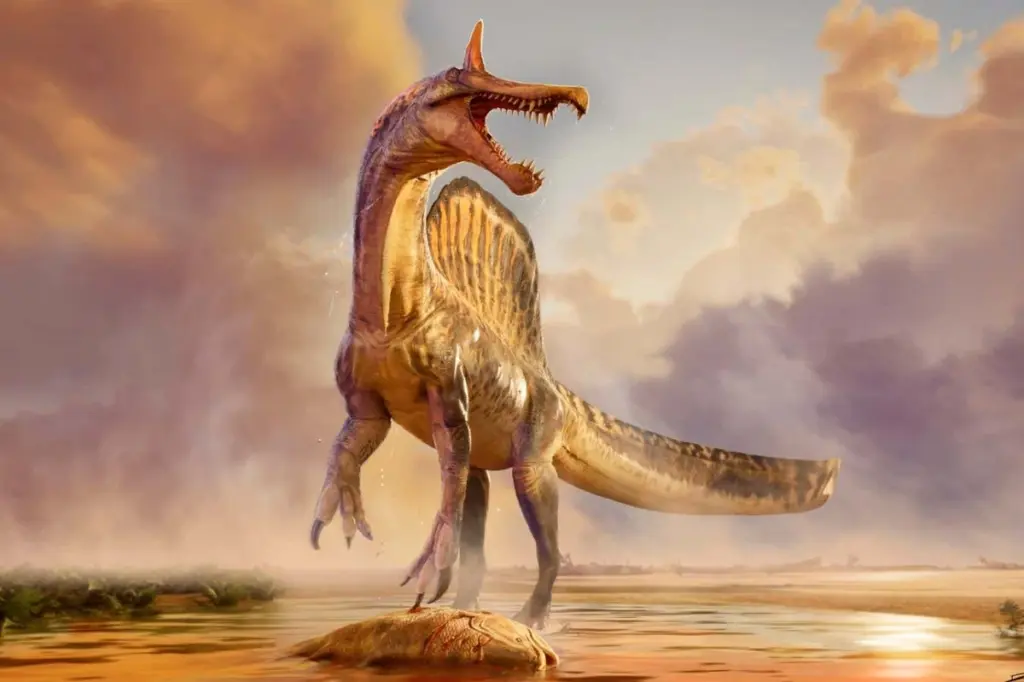
The enduring debate surrounding spinosaurs – whether these mysterious dinosaurs were expert swimmers capable of deep dives or had a lifestyle akin to “hell herons” snatching fish from shallow waters – may be nearing a resolution. Fossils of a newly identified spinosaur species, which inhabited an area approximately 1000 kilometers inland, strongly support the hypothesis that it was a wading predator.
“As far as I’m concerned, this is the coup de grâce for the swimming theory,” stated Paul Sereno, a paleontologist at the University of Chicago.
A Contentious Prehistoric Puzzle
The lifestyle of spinosaurs has long been a point of contention among paleontologists. This fascination stems from the animal’s unusual combination of traits, including a prominent sail-like structure on its back, formidable claws, broad feet, and jaws resembling those of a crocodile. Early popular depictions, such as the BBC’s 2025 series *Walking With Dinosaurs*, portrayed them as aquatic hunters.
Discovery in the Remote Desert
In 2019, a local guide led Sereno’s team to a remote desert locale in Niger. There, they unearthed fragments of jawbones that were later identified as belonging to a spinosaur. The challenges of the remote location, compounded by the COVID-19 pandemic, delayed the team’s return to the site for several years.
During their subsequent expedition, Sereno and his colleagues discovered skeletal remains from approximately ten individual spinosaurs. Within hours of their initial findings, the team recognized a significant feature: these spinosaurs possessed a large crest atop their skulls, in addition to the characteristic sail running along their spines.
“It was a glorious moment,” Sereno recalled. “We knew this was a new spinosaur, something that would fundamentally alter our understanding of this animal.”
Introducing *Spinosaurus mirabilis*
The newly identified species, designated *Spinosaurus mirabilis*, is estimated to have lived around 95 million years ago. The team calculates its length to have been between 10 and 14 meters, making it nearly as large as the most recognized spinosaur species, *Spinosaurus aegyptiacus*.
“I wouldn’t want to be near this animal,” Sereno commented, “as it would finish off a human in about 3 seconds.”
*S. aegyptiacus* also featured a crest, but the newly discovered species boasts a significantly larger one. The bony portion of the skull crest on larger individuals would have measured at least 40 centimeters in height. Drawing comparisons with modern birds that possess cranial crests, such as the helmeted guineafowl, the researchers suggest that this bony structure was likely covered by a keratinous sheath, potentially increasing its total height to at least 50 centimeters.
The delicate nature of the crest suggests it served no purpose as a weapon. “It was probably brightly colored,” Sereno speculated. “Its function was likely to signal, ‘I am here; I am healthy.'”
The Role of Visual Display
The large sails observed on spinosaurs are also believed to have been utilized for visual display, according to Sereno. “So, these animals were quite focused on display, and the question is, why?”
One potential answer lies in the theory that spinosaurs hunted along riverbanks, where territorial defense might have been crucial. “The prevalence of visual cues in environments such as beaches or riverbanks tends to be heightened because it’s there that one can scan for a mile, unobstructed, and spot a competitor or a mate much more readily than in a typical land environment,” Sereno explained.
Evidence Supporting a Wading Lifestyle
Sereno points out that modern wading birds, like the great blue heron, are also highly oriented towards visual display. Furthermore, other characteristics of spinosaurs align with the wading hypothesis. When Sereno’s team plotted various animals on a graph based on the relative proportions of their jaw, neck, and hind limbs, spinosaurs occupied a position adjacent to waders such as herons.
“It couldn’t swim well because of this enormous sail that made it highly unstable in water,” Sereno stated. “However, as a full adult, it could wade into water three meters deep.”
Additionally, the discovery of this spinosaur species far inland contrasts with most other spinosaur finds, which have been located closer to ancient sea margins. Sereno notes that no marine predator weighing over a ton has historically transitioned into freshwater environments. While river porpoises and dolphins exist, river orcas are absent. “Therefore, I believe this all points to the same conclusion: these animals were akin to mega-heron-type creatures.”
Expert Opinions on the Findings
David Hone, from Queen Mary University of London, remarked that the research “really confirms much of the consensus that has been building for these animals.” He elaborated, “They were not exceptional swimmers or deep divers, but rather resembled herons or storks, wading into water to capture prey, primarily fish.”
Hone considers the identification of a new species “fairly convincing.” He added, “If it were solely the crest, this could easily be considered variation, but there are also observable differences in the jaws and teeth.”
Mark Witton, based at the University of Portsmouth, UK, observed, “At face value, the fact that the legs were neither particularly short nor undermuscled suggests it was no less capable of walking and wading than any other predatory dinosaur. This does not bode well for proposals of aquatic lifestyles, which already face challenges concerning the stability and propulsion of a swimming Spinosaurus.”
Journal Reference: Science DOI: 10.1126/science.adx5486