
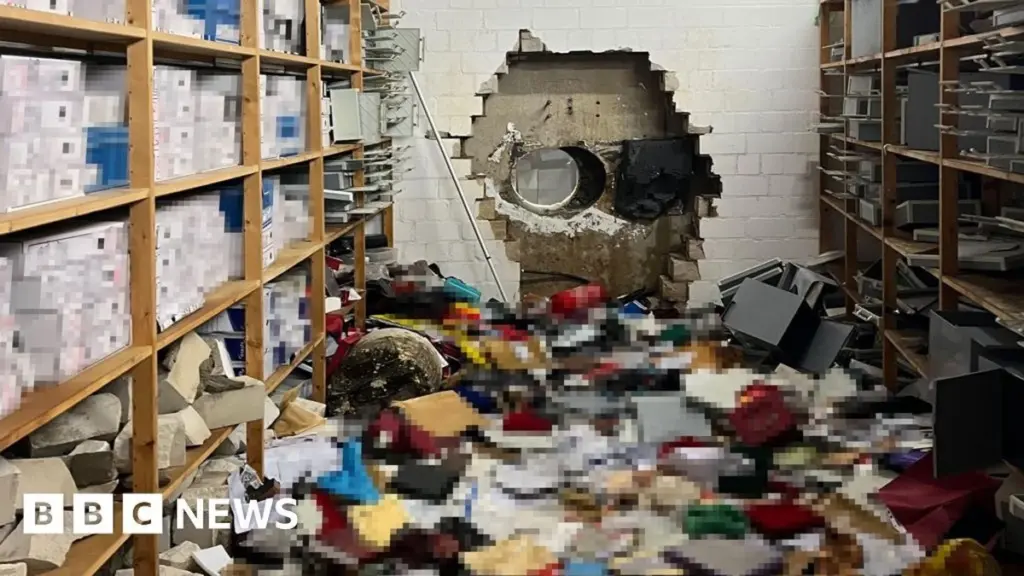
Described as Germany’s most “spectacular” bank heist in recent memory, a daring robbery unfolded over a quiet holiday weekend, leaving authorities and victims reeling.
The incident occurred in Gelsenkirchen, a town in western Germany. A group of thieves bypassed security systems and meticulously planned their operation. They gained entry to a High Street bank by drilling through an adjacent wall using industrial equipment. This allowed them access to over 3,000 safe deposit boxes, from which they absconded with millions of euros.
More than a month later, law enforcement has yet to apprehend any suspects. For the bank’s clients, the impact has been devastating. Many report losing their life savings, precious family heirlooms, and other significant valuables. This experience has brought on a wave of anger, confusion, and shock, profoundly shaking their trust in established institutions.
Unanswered Questions and Security Lapses
The perplexing nature of this crime has prompted significant scrutiny and raised a multitude of critical questions. Herbert Reul, the interior minister for the western state of North Rhine-Westphalia, has articulated several key concerns. The fundamental question of how such a large-scale operation could proceed unnoticed is paramount.
Authorities are investigating the possibility of an inside job to explain the thieves’ intimate knowledge of the bank’s layout and security measures. The apparent silence during the drilling operation and the precise location of the vault are also subjects of intense investigation. Concerns have also been raised regarding the adequacy of the bank’s security systems to prevent such a breach.
Gelsenkirchen police have issued appeals for witnesses to come forward, seeking any information that could aid the investigation.
The Mechanics of the Break-In
Investigators believe the perpetrators likely gained access to the Sparkasse savings bank on Nienhofstrasse via an adjacent multi-storey car park. The thieves are suspected to have tampered with an escape door connecting the car park to the bank. Under normal circumstances, this door is inaccessible from the outside. However, the gang is thought to have ensured the door no longer closed properly, facilitating “unhindered access from the car park to the Sparkasse building.”
From this point, law enforcement suspects the thieves navigated past several security systems. Their objective was an archive room located next to the main vault in the bank’s basement. Here, they deployed their drilling equipment. A hole, approximately 40 cm (15.7 inches) wide, was bored through the wall leading directly into the strongroom housing the safe deposit boxes.
A Near Miss and a False Alarm
Officials estimate the heist took place between Saturday, December 27, and Monday, December 29. Investigators theorize the burglars may have narrowly avoided detection shortly before reaching their ultimate target, the vault.
At approximately 06:00 on December 27, both the Gelsenkirchen fire brigade and a private security firm received a fire alarm originating from the bank. It is possible the thieves inadvertently triggered this alarm. Police and twenty firefighters responded promptly, arriving at the bank by 06:15. However, their initial inspection revealed no obvious signs of compromise, according to a police statement.
Herbert Reul later revealed that the fire alarm had indeed come from the vault itself. Access to the vault, however, was restricted by a locked roll shutter. The firefighters reported seeing “no smoke, no smell of fire, or damage.” Based on these observations, they concluded it was a false alarm, a situation Reul noted was not uncommon.
During an address to a state parliament committee, Reul stated that police did not possess the legal authority to search the bank at that juncture, as it fell under the jurisdiction of the fire brigade. A warrant would have been necessary for such an inspection.
The Looting and the Aftermath
Once inside the vault, the thieves systematically opened nearly all of the 3,250 safe deposit boxes. They removed cash, gold, and jewelry. Reul indicated that the bank’s computer systems logged the first box being breached at 10:45 on December 27 and the last at 14:44. It remains unclear whether the majority of boxes were opened within that four-hour window or if the recording system encountered technical issues.
Later, witnesses reported seeing several men carrying large bags through the car park stairwell during the night of December 27 into December 28. Authorities have not provided an exact figure for the value of the stolen goods. However, German media outlets have estimated the thieves’ haul could be as high as €100 million (£87 million).
Following the discovery, police released surveillance footage from the car park. The images showed individuals with covered faces and two vehicles: a black Audi RS 6 and a white Mercedes Citan. Both vehicles were equipped with counterfeit license plates.
Discovery and Devastation
The full extent of the theft was only realized on December 29, when another fire alarm sounded at 03:58 on Monday morning. Firefighters returned to the bank to confront a scene of utter disarray. Herbert Reul described the aftermath as resembling “a rubbish dump,” with over 500,000 items scattered across the floor – the contents of the safe deposit boxes that the thieves had discarded.
Police reported that many items had been damaged by water and chemicals, which the thieves had allegedly used to obscure evidence. Investigators have since been engaged in a painstaking process of sifting through the debris, searching for clues and attempting to identify the rightful owners of the recovered items.
Client Impact and Legal Recourse
As details of the heist emerged, approximately 200 clients gathered outside the Sparkasse, demanding access. Police responded with multiple patrol cars to secure the entrance.
Joachim Alfred Wagner, 63, recounted his immense loss, which included gold valued in the tens of thousands of euros, along with jewelry inherited from his parents and grandparents. He had opted to rent a safe deposit box following several burglaries at his apartment, believing his valuables would be secure. “I cried with rage,” he stated.
The bank has indicated that the contents of safety deposit boxes are generally insured up to €10,300 per box. Wagner is among the initial clients to file a lawsuit against the bank, seeking damages for what his lawyer, Daniel Kuhlmann, termed “lax security.” Another victim had deposited €400,000 in cash, proceeds from the sale of a property intended for their retirement.
The bank has maintained that it is also a victim of the crime, asserting that its facilities were “secured in accordance with recognized state-of-the-art technology.”
While some clients possessed official receipts for the contents of their deposit boxes, a significant number did not. “Even the Sparkasse doesn’t know what is in [the boxes] because each person can put whatever they want into them,” Herbert Reul observed.
He emphasized the profound psychological impact of the event, stating, “We need to help the victims. For many, this is more than just the loss of property; this can also impact their trust in their own sense of security and… their trust in our order.”
A Landmark Criminal Case
Police Chief Tim Frommeyer characterized the investigation as “one of the biggest criminal cases in the history of the state of North Rhine-Westphalia.” He added, “My department and all of its employees are aware of the magnitude of this case. The financial damage, uncertainty, and frustration run deep!”
Political Ramifications and Public Sentiment
Shortly after the theft’s discovery, Germany’s far-right Alternative for Germany (AfD) party held a rally outside the bank. This prompted accusations that the party was attempting to exploit the situation for political gain.
German magazine Der Spiegel suggested that the heist had transcended its criminal nature to become a political issue. It was seen as a symbol of deeper societal concerns: “The feeling that promises of security are hollow, that institutions are failing, that ultimately no-one is being held accountable.”