
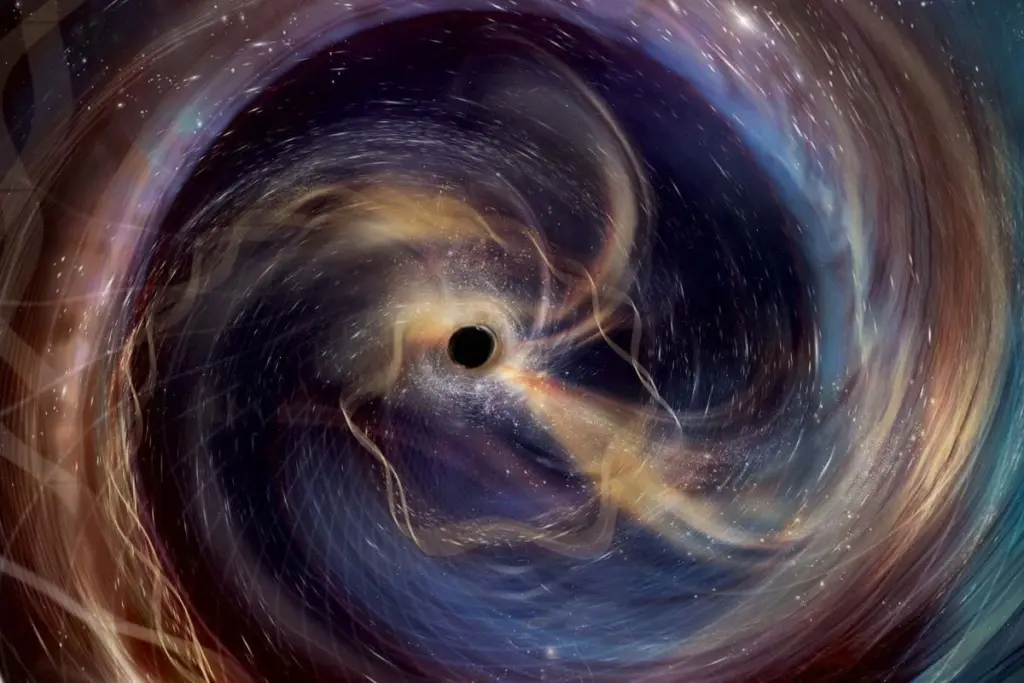
The most powerful collision between two black holes ever detected has provided scientists with an unparalleled opportunity to scrutinize Albert Einstein’s theory of general relativity. The findings confirm the accuracy of the physicist’s long-standing predictions.
In 2025, a global network of highly sensitive laser-based gravitational wave detectors intercepted a profound disturbance in the fabric of spacetime, designated GW250114. This event is believed to have originated from the merger of two black holes.
These detectors, which include the Laser Interferometer Gravitational-Wave Observatory (LIGO) in the United States and the Virgo detector in Italy, possess significantly advanced sensitivity compared to the instruments present during LIGO’s initial detection in 2016. Consequently, GW250114 yielded the clearest, least noisy data of any gravitational wave event recorded to date. This made it an exceptional subject for testing predictions derived from established physical theories.
Testing Black Hole Theories
The previous year saw researchers analyzing GW250114 data to examine Stephen Hawking’s theorem, formulated over half a century ago. This theorem posited that the event horizon of a merged black hole—the boundary beyond which nothing, not even light, can escape—would not be smaller than the combined event horizons of the original black holes. The analysis indicated with near 100 percent certainty that Hawking’s proposition was correct.
Focus on Einstein’s Relativity
Building on this, Keefe Mitman from Cornell University in New York, along with his colleagues, has conducted further research. Their work specifically investigates whether the black hole merger aligns with Albert Einstein’s theory of general relativity.
Einstein’s foundational equations delineate the motion of any mass through spacetime. When these equations are adapted to model the merging of two black holes and subsequently solved, a distinct pattern of events emerges. The black holes begin to orbit each other at increasing velocities, culminating in a dramatic collision. This event releases an immense surge of energy, followed by physical oscillations at specific frequencies, akin to the resonance of a struck bell.
These characteristic frequencies, known as ringdown modes, have historically been too faint to detect in prior gravitational wave events. However, GW250114 was sufficiently powerful to allow for a rigorous examination of the modes predicted by Einstein’s equations. Mitman and his team utilized simulations of Einstein’s equations to generate predictions regarding the amplitude and frequencies of these black hole vibrations. Their comparison of these predicted values with the measured frequencies revealed a close alignment.
“The amplitudes that we measure in the data agree incredibly well with the predictions from numerical relativity,” stated Mitman. “Einstein’s equations are exceptionally challenging to solve, but when we do, and when we observe predictions of general relativity in our detectors, those two align.”
Laura Nuttall of the University of Portsmouth in the UK commented, “The upshot is Einstein is still correct. Everything seems to look like what Einstein says about gravity.”
Limitations and Future Prospects
Despite the significant magnitude of GW250114, the frequencies detected remained subtle enough that Mitman and his team could not definitively rule out deviations from Einstein’s predictions exceeding approximately 10 percent. This margin of uncertainty is largely attributable to the current limitations in detector sensitivity, according to Mitman. He anticipates that this uncertainty will diminish as gravitational wave detectors are further refined.
However, if Einstein’s theory contains inaccuracies, this discrepancy may persist. Mitman explained, “As we observe more and more events, or see louder single events, what could happen is that those error bars could just shrink to being around zero, or it could shrink to being away from zero. If it shrinks to being away from zero, that’s much more interesting.”
Journal reference: Physical Review Letters, DOI: 10.1103/6c61-fm1n