
Sebastião Salgado garnered significant recognition for his striking portraits capturing human resilience amidst a world marked by injustice and violence. His lens documented pivotal moments, including the attempted assassination of U.S. President Ronald Reagan, and he extensively covered conflicts across Africa, the Balkans, and the Middle East. Furthermore, Salgado dedicated years to undertaking vast, globe-spanning projects, meticulously documenting the lives of laborers and migrants.
Following his harrowing experience photographing the Rwandan genocide, Salgado fell into a deep depression. He subsequently retreated to his family’s farm in Brazil. Confronted by the extensive environmental degradation he observed there, he initiated a personal mission to restore the Atlantic rainforest on his land. This endeavor ultimately reignited his passion for photography, leading to the genesis of his “Genesis” project. As Salgado articulated in a 2024 interview, the aim was to capture “what was pristine and hadn’t been destroyed” across the planet, from the vast mountain ranges of Alaska to the Indigenous communities of the Amazon basin. These extensive travels, he noted in another interview, profoundly transformed him into an ardent environmentalist.
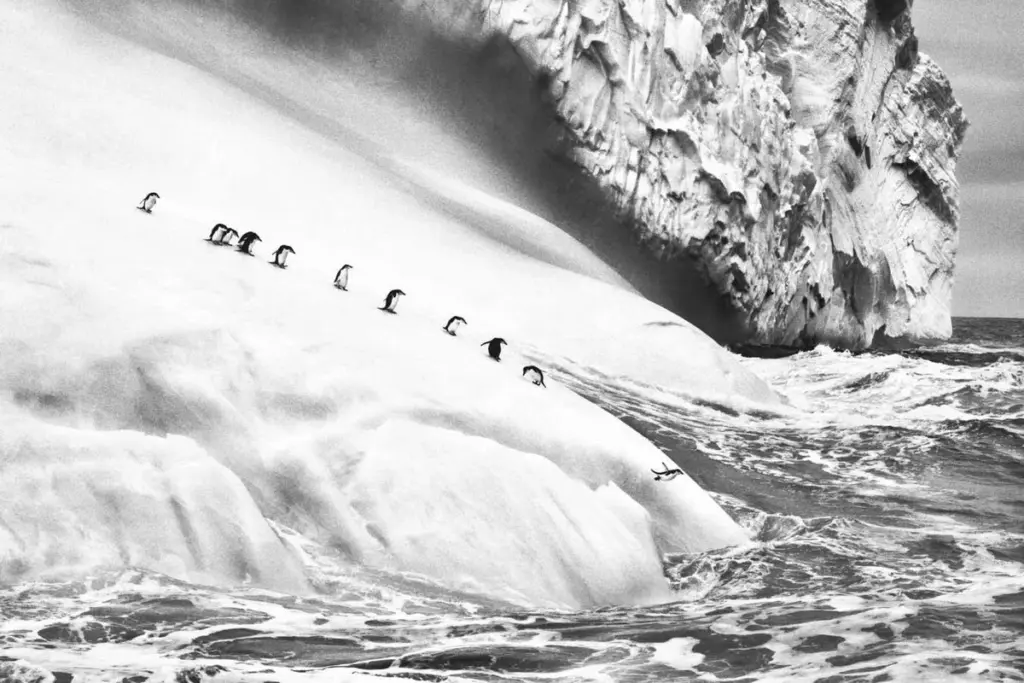
The recently published book “Glaciers,” released this month following Salgado’s passing last year, presents sixty-five black-and-white photographs. These images, all captured for the “Genesis” project, focus on glaciers and other frozen landscapes. The photographs appear to suspend time, offering frozen moments of both the immense and minute movements occurring in the planet’s coldest regions. A prominent image within the collection depicts a procession of penguins diving from an iceberg into the turbulent seas off the South Sandwich Islands. Adjacent to this, another shot captures seabirds in low flight near an ice formation in the same locale.
However, these images, while seemingly timeless, represent a world in flux. Earth is losing approximately 1,000 glaciers annually, and this rate is accelerating. Projections based on current warming trends indicate that by 2100, roughly eighty percent of the world’s glaciers could vanish, encompassing nearly all glaciers in western Canada, the United States, and the Alps.
Featured prominently is Salgado’s photograph of a vast glacier, appearing to snake its way through the mountainous terrain of Kluane National Park in Canada. Below this, clouds drift around an ice formation resembling a mushroom atop Cerro Torre in Patagonia. The final image in this selection illustrates a glacier fragmenting as it separates from the rocky shoreline within Chile’s Torres del Paine National Park, its surface visibly roughened by the relentless flow of ice.