
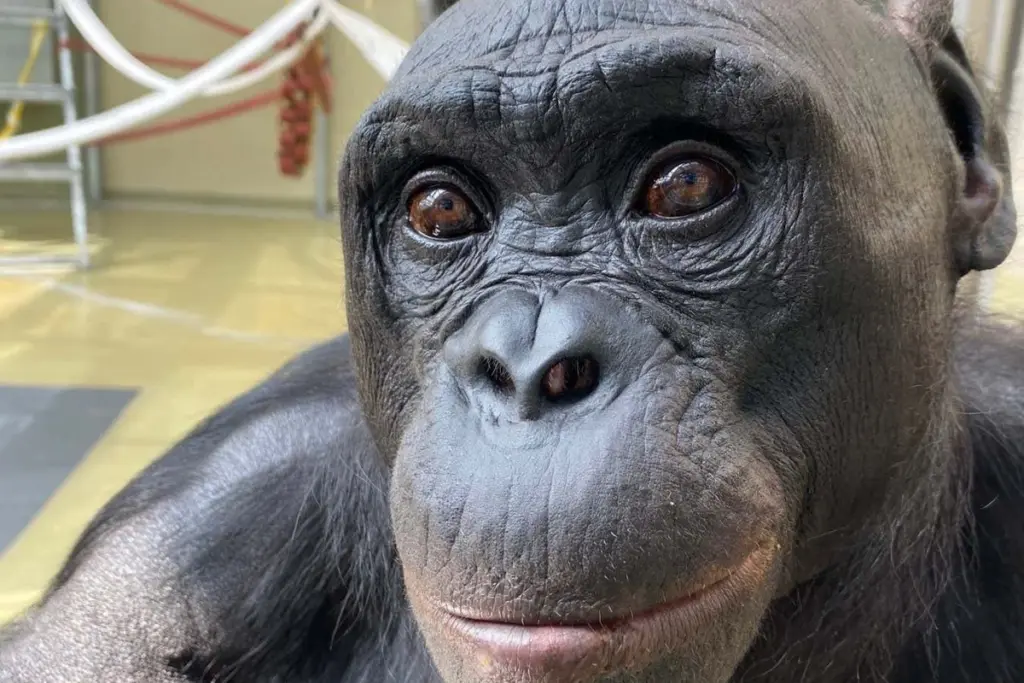
A bonobo named Kanzi demonstrated an ability for make-believe, participating in a simulated tea party akin to those staged by young children. This behavior suggests that our closest primate relatives possess the capacity for pretend play.
Kanzi, a bonobo (Pan paniscus), was born in the United States in 1980 and passed away in March of the previous year at the age of 44. He resided for the majority of his life at the Ape Initiative in Des Moines, Iowa. During his time there, he became well-known for his facility in communicating through the use of symbols on a board.
In the year leading up to his death, Amalia Bastos, affiliated with the University of St Andrews in the UK, along with her colleagues, conducted a series of experiments. These studies aimed to ascertain whether Kanzi, in addition to his advanced language skills, could also engage in what researchers term “secondary representations.” This refers to the cognitive capacity to visualize an alternative reality and, in certain contexts, to share this conjured scenario with another individual – a skill that typically develops in humans during their early childhood.
Bastos explains that children between the ages of two and three years can follow the movement of imaginary liquid between containers, accurately tracking where the “tea” is present or absent. “That’s precisely the kind of scenario we presented to Kanzi to explore this ability in a non-human animal,” she stated.
Experiment Stages and Findings
The initial phase of the experiment involved researchers simulating the pouring of non-existent juice into two unoccupied cups. They then mimicked emptying one of these cups before asking Kanzi to choose between them. On more than two-thirds of occasions, Kanzi selected the cup that was not emptied and was understood to still contain the pretend juice.
Bastos commented, “If Kanzi had not grasped the concept of ‘imaginary juice’ in the cups throughout the study, he would have selected between the two cups at random, given that they were both empty.”
Subsequently, the researchers placed one empty cup and another containing actual juice before Kanzi. He consistently opted for the cup with the juice, choosing it more than three-quarters of the time. This particular test served to verify that the bonobo could distinguish between real and fabricated juice.
For the third part of the study, the team began by placing a real grape into one of two cups. Kanzi invariably chose the cup with the real grape. Following this, a pretend grape was placed in each of two cups, after which one was notionally emptied. Again, in over two-thirds of these attempts, Kanzi accurately selected the cup that still held the pretend grape.
Bastos emphasized that all studies conducted with great apes by her team are entirely voluntary. “The fact that Kanzi remained engaged and continued to participate even in trials where he knew there would be no tangible reward suggests to me that he must have at least found it somewhat enjoyable,” she remarked.
Expert Commentary
Gisela Kaplan, from the University of New England in Armidale, Australia, described the experiment as “unambiguous in demonstrating that the bonobo understood the pretense and is participating in the game.”
She further commented, “This experiment is clean and simple, mirroring child play with doll houses, where children serve cups of tea to each other in tiny mugs and pretend to drink, or offer pieces of cake that are not real.”
Miguel Llorente, based at the University of Girona in Spain, referred to Kanzi as the “Einstein of his species.” Llorente’s current research interest lies in understanding the origins and mechanisms behind the emergence of such imaginative capabilities.
He hypothesized, “His lifelong exposure to symbolic language and human interaction likely served as a potent cognitive framework, enabling him to externalize and refine mental faculties that might otherwise remain dormant in wild bonobos.” Llorente added, “While Kanzi represents the cognitive peak of his species, his performance indicates that the fundamental biological basis for imagination was already present in our common ancestor between 6 and 9 million years ago.”