
The scientific understanding of quantum effects, once thought to be exclusively confined to the subatomic realm, is progressively expanding into the macroscopic world we inhabit. Recent experimental findings have demonstrated quantum phenomena in metallic particles roughly the size of some viruses. This achievement sets a new record for the most macroscopic objects to exhibit quantum properties, reminiscent of the hypothetical Schrödinger’s cat.
Erwin Schrödinger’s 1935 thought experiment involved a cat in a quantum superposition, simultaneously alive and dead. This was intended to highlight what he perceived as the absurdity of quantum mechanics when applied universally. In such a state, the cat’s condition would remain indeterminate without direct observation, leading Schrödinger to describe it as being in an unsettling, composite state. Since the observable world does not present cats in such paradoxical conditions, researchers generally hold that objects exceeding a certain size lose their quantum characteristics. This loss, including the capacity for quantum superposition, is attributed to environmental disturbances, a process known as decoherence.
However, the precise threshold at which this transition occurs, and whether a definitive boundary between quantum and classical physics must necessarily exist, remains an active area of inquiry. Sebastian Pedalino and his research team at the University of Vienna in Austria have now extended the observable limit of quantum behavior into the macroscopic domain further than previously accomplished.
Pedalino noted that standard quantum mechanics does not specify any definitive limits concerning mass, size, or the distance of superposition. “We don’t know if there might be any fundamental limit or new physics that is connected to the mass or the size [of an object],” he stated, emphasizing that such questions necessitate resolution through continued measurement and experimentation.
The experimental procedure involved a sodium nanoparticle interference test. This type of experiment allows researchers to detect quantum superposition by observing a distinct signal when the object is directed towards a detector. The methodology is analogous to experiments where light passes through two parallel slits, creating an interference pattern of light and dark stripes on a screen. This pattern arises from the constructive and destructive interference of light waves. Similarly, a particle in a quantum superposition state, conceptually existing in multiple states simultaneously, behaves like a “matter wave.” Each of these coexisting states interferes with the others.
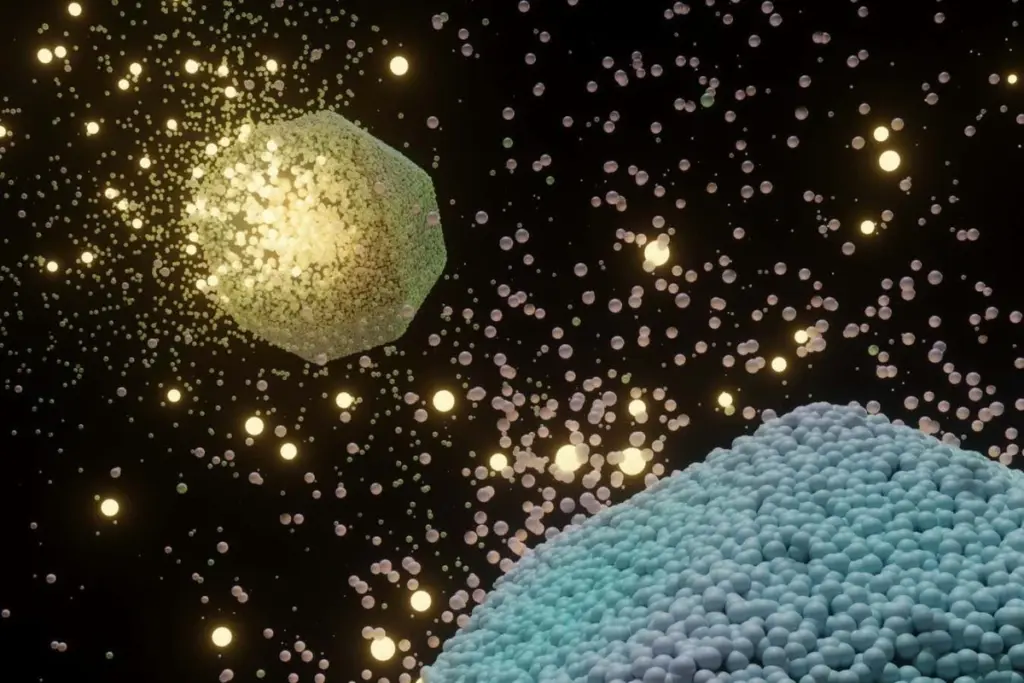
Pedalino’s team successfully generated an interference pattern using sodium nanoparticles, each composed of over 7000 atoms. These nanoparticles were induced into a state simulating Schrödinger’s cat, existing in a duality of two positions. The separation between these two positions was approximately 16 times the physical dimension of a single nanoparticle. This suggests that each nanoparticle can be conceptualized as a probability wave extending significantly beyond its physical boundaries.
Pedalino explained that the ‘size’ of a quantum phenomenon is not solely determined by an object’s physical dimensions or mass. He highlighted that the spatial separation between superposed states and the duration of this superposition, despite decoherence, are also critical factors. Consequently, physicists often employ the term “macroscopicity,” which quantifies the extent to which an object challenges the principles of quantum mechanics. With a macroscopicity score of 15.5, the experiment conducted by Pedalino’s team has established a new benchmark.
Matteo Fadel at ETH Zürich in Switzerland commented that achieving a macroscopicity of 15.5 signifies an approximately tenfold increase in the “size” of previously observed quantum effects, thereby extending the applicability of quantum mechanics to systems comparable in size to a large virus. He described this as a remarkable finding.
Rainer Kaltenbaek at the University of Ljubljana in Slovenia also deemed the accomplishment impressive.
Stefan Nimmrichter from the University of Siegen in Germany pointed out that the recent work represents not only a significant technological advancement—requiring nanoparticles to be maintained in an ultra-high vacuum, substantially slowed, and cooled to enter a decoherence-resistant quantum superposition state—but will also contribute to theoretical investigations seeking to explain the absence of quantum effects in everyday experience.
Nimmrichter further noted that while several theories attempt to address this phenomenon, experiments like the current one are progressively narrowing the scope of their potential validity. He stated, “If there is any modification of quantum theory towards the macroscale, we must keep coming up with new ideas [for] how to observe quantum superpositions with even heavier objects and on longer time scales.”
Despite the considerable technical challenges involved, including a two-year effort by Pedalino’s team to obtain the nanoparticle interference pattern, all researchers anticipate that the macroscopicity record will be surpassed in the coming years. Future experiments may potentially reveal quantum effects in objects with macroscopicity scores hundreds of times greater.
Kaltenbaek suggested a practical benefit to this research: the preservation of quantum properties in macroscopic objects could be instrumental in the development of quantum technologies for applications such as simulation and computation. Pedalino’s future research objectives include replicating the experiment with large biological entities, like viruses, at scales comparable to, or exceeding, those of current metal nanoparticles.
He indicated that interference patterns derived from such experiments could serve as highly sensitive tools for probing subtle forces acting upon these objects. Such forces are often difficult, if not impossible, to detect or measure using conventional methods.