
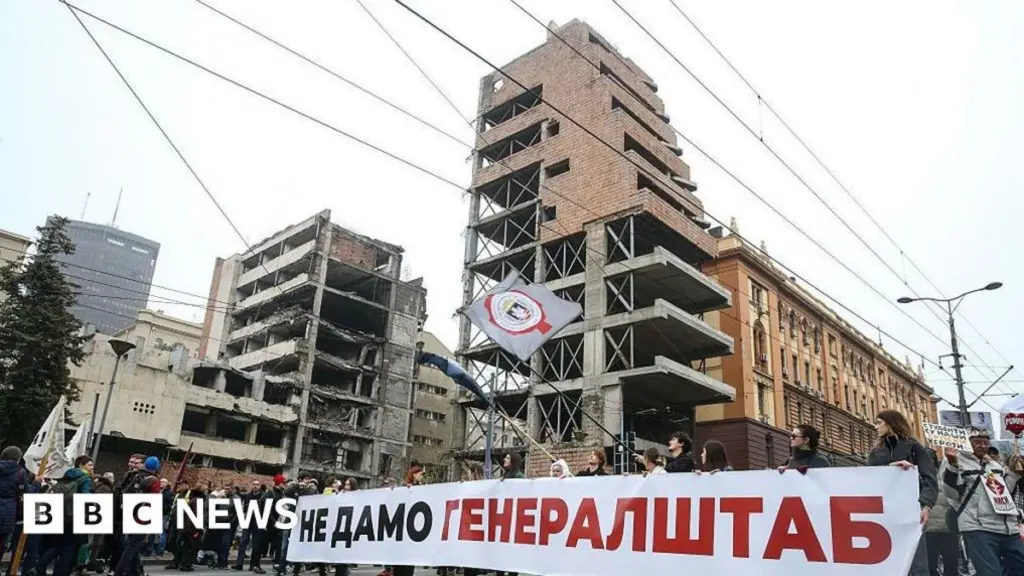
Plans for a Trump International Hotel in Belgrade, the Serbian capital, were envisioned as a symbol of a new era for the nation.
The proposed site was one of the city’s most striking landmarks: the bomb-damaged but still standing complex of the former defense ministry, widely known as Generalstab.
A significant hurdle emerged early on. Generalstab was officially designated as cultural heritage, presenting a challenge that the government sought to overcome.
One approach involved removing the complex from the list of protected buildings. However, this action has led to the current legal proceedings against the Minister of Culture, Nikola Selakovic. He faces charges of abuse of office, accused of leveraging his position to influence or alter documents to strip Generalstab of its protected status.
Prosecutors are seeking a three-year prison sentence for the minister. President Aleksandar Vucic has publicly stated his intention to pardon Selakovic should he be convicted.
Regardless of the legal outcome, the prospect of a Trump International Hotel gracing Belgrade now appears remote.
The project faced an uphill battle from its inception, particularly given the complex history between the United States and Serbia. NATO airstrikes in 1999, which left Generalstab in its current state, were conducted by US warplanes. Furthermore, US support for Kosovo’s 2008 declaration of independence from Serbia contributed to lingering sentiment among many Serbians.
Consequently, the 2024 announcement of a deal between Serbia’s government and Jared Kushner, US President’s son-in-law, to redevelop Generalstab through his Affinity Global company, was met with widespread surprise.
This surprise evolved into public outcry when Kushner unveiled plans for a Trump International Hotel to be the project’s focal point.
President Vucic argued that the moment was opportune for Serbia to “overcome the burden from 1999.” He expressed to the BBC previously his government’s willingness to foster improved relations with the US, deeming it “terribly important for this country.”
It soon became evident that a considerable portion of the Serbian public did not share this view, especially concerning the Generalstab site.
Opposition to Kushner’s development initiative united a diverse group: architects, military veterans, and student-led anti-corruption activists. The architects highlighted the bombed buildings as the sole Serbian project by the esteemed Yugoslav architect Nikola Dobrović. Veterans viewed the structures as an unofficial memorial to those who perished in the 1999 airstrikes. Students, meanwhile, pointed to the absence of a tender process for the deal with Affinity Global.
These objections did not deter the government’s push to advance the project. In November, special legislation was passed by the National Assembly to facilitate the construction of the Trump Hotel.
Simultaneously, prosecutors were investigating the matter, with a particular focus on the actions taken to remove Generalstab from the heritage register. This investigation culminated in charges being filed against the culture minister and three other officials in December.
Minister Selakovic reacted by denouncing the prosecutors as an “organized criminal group” and an “autoimmune disease,” alleging they were “targeting the president.”
However, these charges proved to be the breaking point for Kushner’s involvement. His company issued a statement indicating a desire to “unite rather than divide” and cited their withdrawal as a gesture of “respect for the citizens of Serbia and the City of Belgrade.”
President Vucic has not concealed his strong disapproval of the prosecution, describing it as “shameful and pathetic” and “disgusting political manipulation.”
Last month, his party successfully passed amendments to judicial laws, despite warnings from critics that these changes could undermine the independence of prosecutors and judges. Marta Kos, the EU’s Enlargement Commissioner, characterized the legislation as a “serious step backwards,” noting its rapid and non-transparent adoption without consultation.
Protesters have returned to the streets of Belgrade, currently gathering outside the courthouse where the minister’s trial is underway. A banner displayed read, “we are all witnesses.”
For Jared Kushner, attention has shifted to Albania, where he intends to develop a luxury resort on Sazan Island. Albania’s Prime Minister, Edi Rama, has expressed his contentment with the plans.
It remains uncertain whether a Trump International Hotel is part of the proposed development in Albania.