
Russia has initiated its most significant aerial assault on Ukraine in recent memory, specifically targeting power plants and energy facilities across Kyiv and numerous other locations. This offensive occurred as temperatures plummeted below minus 20 degrees Celsius overnight.
The attacks have resulted in over a thousand apartment buildings in the capital losing their heating once again. Additionally, a power plant situated in the eastern city of Kharkiv has sustained irreparable damage. President Volodymyr Zelensky characterized Russia’s actions as a deliberate choice of “terror and escalation” over diplomatic solutions to conclude the ongoing conflict. He strongly advocated for Ukraine’s allies to exert “maximum pressure” on Moscow.
This extensive assault follows the expiration of a so-called “energy truce,” which had been brokered by Donald Trump in discussions with Vladimir Putin. However, for many Ukrainians, there has always been an imperceptible gap between Russian largescale strikes, leading to doubts about the genuine existence of any substantial pause in hostilities.
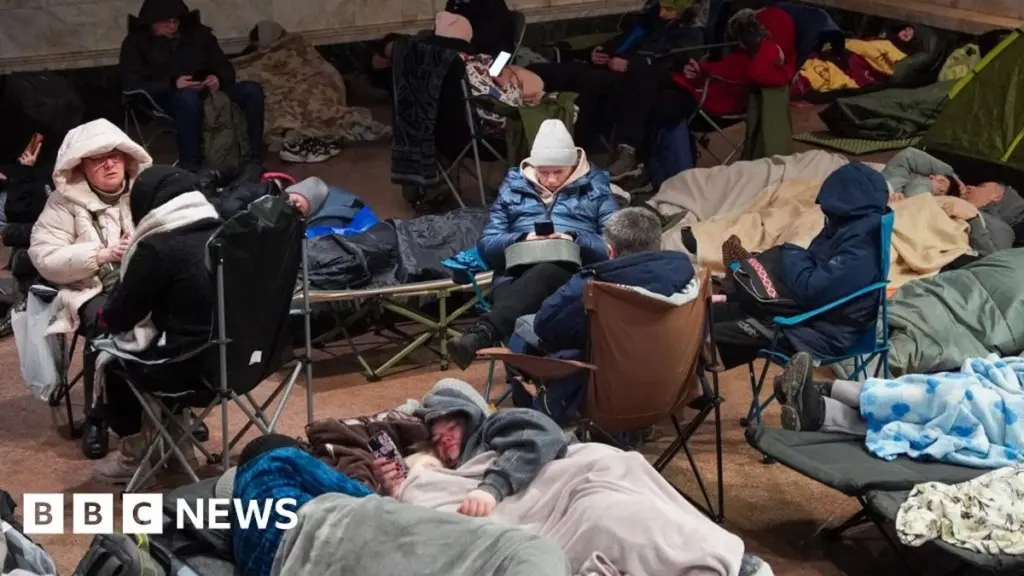
Residents in Kyiv reported hearing the initial explosions shortly after midnight. The air raid alert persisted for over seven hours, punctuated by several subsequent detonations. Many inhabitants sought refuge in metro stations throughout the night, with some setting up tents on the platforms to shield themselves from the severe cold.
President Zelensky stated that more than 70 ballistic and cruise missiles, a significantly higher number than usual, were deployed. These were accompanied by approximately 450 drones, intended to overwhelm Ukraine’s air defense systems. According to the Ukrainian Air Force, only 38 of the incoming missiles were successfully intercepted, indicating that a substantial number reached their intended targets.
Ukrainian officials have consistently voiced concerns regarding a persistent shortage of interceptor missiles necessary for air defense. The nation’s reliance on US-manufactured Patriot missiles is particularly noteworthy. “Timely delivery of missiles for air defense systems and the protection of normal life are our priority,” Zelensky commented on X the following morning. “Without pressure on Russia, there will be no end to this war.”
Diplomatic Efforts Interrupted by Renewed Offensive
The timing of this offensive coincided with Ukrainian President Zelensky’s meeting with NATO Secretary-General Mark Rutte in Kyiv. Rutte was also scheduled to address the national parliament during his visit.
Furthermore, negotiators from Russia and Ukraine were slated to convene in Abu Dhabi for another round of talks this week, coordinated by the United States. The preceding “pause” in attacks on energy infrastructure was reportedly an initiative by Donald Trump, designed to provide an opportunity for diplomatic progress. However, Russia’s actions clearly indicate a different strategic direction.
Winter Offensive Aims to Terrify Civilians
Volodymyr Zelensky has accused Moscow of exploiting the coldest winter months to “terrorise people.” The private energy company DTEK confirmed that two of its power plants were struck for the ninth time since October. State-run facilities in Kyiv and other regions also sustained damage, compounding the extensive harm inflicted by prior targeted assaults.
Each subsequent attack exacerbates the difficulty of conducting repairs, rendering the energy system increasingly fragile and susceptible to widespread blackouts. Engineering teams have been engaged in round-the-clock efforts for weeks to restore functionality, with specialists drafted from across the country and widely praised for their dedication. Nevertheless, the available workforce is insufficient to meet the escalating demand.
Interviews with residents revealed instances of prolonged heating outages, lasting for days or even weeks. Many people wear hats and coats indoors and pile blankets for warmth, yet the cold remains severe. A significant number rely on soup kitchens for free hot meals due to the frequent and extended power cuts. There is a prevalent belief among the populace that these attacks are designed to incite public opposition against the government in Kyiv, making life unbearable to the point of accepting Russia’s demands, including the cession of territory in the eastern Donbas region currently under Ukrainian control.
Resilience and Determination Amidst Attacks
Instead of yielding, the attacks have fostered widespread anger towards Russia for its attempts to freeze civilians and a firm resistance to any compromise with Moscow. “Russia won’t get what it wants,” a resident named Vera stated over the weekend while queuing for a bowl of stew served by volunteers. “We are stronger than them in any case.”
Another resident, Volodymyr, explained his plan to temporarily reside in a local school equipped with a generator for heating. “In the daytime you move around a bit,” he said. “But at night it’s really cold.” He expressed deep frustration with Russia, stating, “They are bombing civilians. They want us to freeze and die.”
The recent offensive resulted in damage to several residential buildings, which caught fire from falling debris as Ukrainian forces engaged in intercepting missiles and drones. Reports indicate that several individuals sustained injuries.