
Vladimir Solovyov, a prominent Russian television presenter, launched a furious verbal assault, directing his anger towards the United Kingdom.
His words, broadcast on his show, conveyed a distinct sense of disappointment. “We still haven’t destroyed London or Birmingham,” he declared. “We haven’t wiped all this British scum from the face of the earth.”
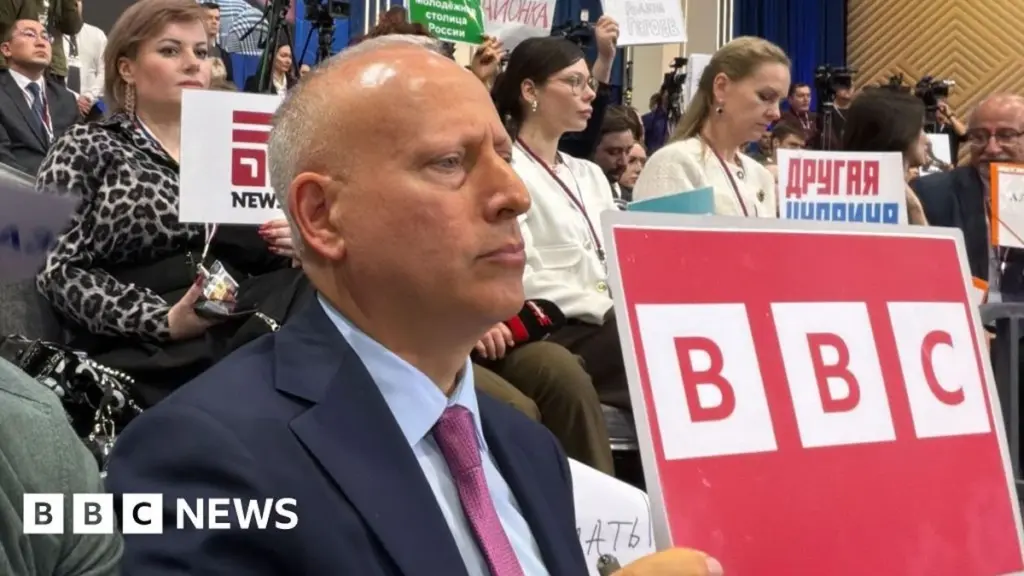
The tirade continued, targeting foreign correspondents. “We haven’t kicked out the goddamned BBC with that Steve Rotten-berg,” Solovyov barked, referring to me. “He walks around looking like a defecating squirrel…he’s a conscious enemy of our country!”
This is the environment in which BBC correspondents operate in Russia. My experience is chronicled in “Our Man in Moscow,” a BBC Panorama film that examines a year in the life of the BBC’s Moscow bureau amidst the ongoing conflict in Ukraine, the Kremlin’s domestic crackdown, and evolving relations with global powers.
The insult about a “defecating squirrel” does not particularly bother me; squirrels are rather charming creatures. Furthermore, their thick skin is a quality essential for any foreign correspondent stationed here.
However, being labeled an “enemy of Russia” is deeply hurtful. I have dedicated over three decades to living and working in Moscow. My affinity for Russia began early, captivated by its language, literature, and music. During my university years in Leeds, I led a choir that performed classic Russian folk songs. For one particular concert, I even composed a song in Russian about a snowman who melted after donning excessive layers of clothing.
Much like that snowman, the Russia I once knew seemed to vanish in February 2022. The full-scale invasion of Ukraine marked a descent into a grim chapter for the world’s largest country. President Putin’s “special military operation” rapidly escalated into Europe’s deadliest conflict since the Second World War.
This invasion did not occur in a vacuum. Russia had already annexed Crimea from Ukraine in 2014. Accusations of funding, fueling, and orchestrating an armed uprising in eastern Ukraine had also surfaced. Relations with Western nations were demonstrably deteriorating.
Nevertheless, the full-scale invasion represented a significant turning point.
In the immediate aftermath, new, stringent laws were enacted to suppress dissent and penalize any criticism directed at the authorities. BBC platforms faced blockages. Reporting from Russia abruptly transformed into navigating a precarious legal landscape, akin to walking a tightrope above a minefield. The core challenge became delivering accurate and truthful reporting without succumbing to the overwhelming risks.
The 2023 arrest of a Wall Street Journal reporter underscored that a foreign passport offered no immunity from detention. Evan Gershkovich, a US citizen, was subsequently convicted on espionage charges and spent sixteen months imprisoned. Both he, his employer, and US officials vehemently rejected the proceedings as a charade.
Our team at the BBC’s Moscow office is now considerably smaller. collectively, we endeavor to manage the daily complexities of reporting on Russia.
My producer, Ben Tavener, and I frequently encounter “additional checks” when entering and exiting Russia. Correspondents from nations designated as “unfriendly” by the Kremlin, a category that includes the UK, are no longer issued one-year permits. Our journalist visas and accreditation require renewal every three months.
Many individuals who previously provided us with information are now hesitant to speak. It is likely they perceive associating with the BBC to be an unacceptable risk given the heightened international tensions.
Despite these challenges, alongside other Western broadcasters maintaining a presence in Russia, we continue to receive invitations to Kremlin events.
On occasion, I am presented with the opportunity to question President Putin directly.
Even a single question and answer exchange at a press conference can offer valuable insights into the Russian president’s mindset.
Vladimir Putin’s actions are largely fueled by a deep-seated resentment towards the West, stemming from NATO’s eastward expansion and his perception of years of disrespect from Western leaders. Critics accuse him of harboring imperialistic ambitions, seeking to re-establish Russia’s sphere of influence.
“Will there be new ‘special military operations’?” I asked President Putin last December as part of a broader inquiry into his future plans. His response was telling: “There won’t be any operations if you treat us with respect. If you respect our interests…”
This statement inherently raises a critical question: what course of action will Vladimir Putin pursue if he concludes that Russia’s interests are disregarded?
With the potential return of Donald Trump to the White House, Moscow perceives a greater likelihood of receiving increased respect from Washington. At the Alaska summit last August, the American president extended a welcoming gesture to Russia’s leader, inviting him to Anchorage. This encounter was intended to bring Vladimir Putin “in from the cold,” despite the summit’s failure to resolve the conflict in Ukraine.
However, not all endeavors have favored Moscow. Venezuela’s president, Nicolás Maduro, a Russian ally, was recently apprehended by US troops. Concurrently, America seized an oil tanker flying a Russian flag in the Atlantic.
Remarkably, the Kremlin has exhibited a notable restraint in its criticism of the United States over the past twelve months. This suggests a belief within Moscow that cultivating a positive relationship with a Trump administration could facilitate an end to the Ukraine war on terms advantageous to the Kremlin.
Consequently, the majority of anti-Western rhetoric disseminated through Russian state media is now directed not at America, but rather at the European Union and the United Kingdom.
The transformation in this sentiment is profound.
In 1997, I was invited to participate in “The White Parrot Club,” a popular Russian television comedy show that featured a talking white parrot named Arkasha. Russian celebrities would convene in a bar setting, sharing British jokes and speaking with affection about the UK.
Film legend Yuri Nikulin recalled his experiences during World War Two: “In 1944 I was on the frontline in World War Two. I remember how Britain and the Allies opened the Second Front. That helped us so much.”
The participants of The Parrot Club invited me to perform a “British song.” I took my place at the piano and sang popular tunes like “Daisy! Daisy!” and “a bicycle made for two.”
Sitting in that Moscow bar, it felt as though Britain held a cherished place in Russian hearts. I distinctly recall thinking that Russia and the West were metaphorically “on that bicycle made for two,” and that the confrontational dynamics of the Cold War were firmly in the past.
That optimistic outlook proved to be unfounded.
Over a span of thirty years, the discourse has shifted dramatically, from “white parrots” to accusations of being “defecating squirrels.”
More significantly, the hopeful prospect of East-West friendship has devolved into a protracted four-year war in Europe, inflicting devastating consequences primarily on Ukraine.
The ultimate resolution of this conflict will undoubtedly shape not only the futures of Ukraine and Russia but also the broader trajectory of Europe.
The past four years have presented moments that have been profoundly shocking. I vividly recall a conversation with a woman named Vera at a highly orchestrated pro-Putin rally in 2022. I inquired if she had a son, to which she confirmed she did.
When I asked if she was concerned about him being drafted into the army and sent to Ukraine, she responded, “I’d rather my son was killed fighting in Ukraine than see him getting up to mischief at home. Look how many young men here have no job and spend their time getting drunk.”
Conversely, there have been moments of unexpected warmth. A few days after television host Vladimir Solovyov publicly denounced me as an “enemy of Russia,” several Muscovites approached me, offering handshakes and requesting photographs.
This duality mirrors Russia’s national symbol, the double-headed eagle. One head issues aggressive pronouncements, labeling one a “defecating squirrel.”
The other head conveys a different sentiment: “Thanks for being here.”