
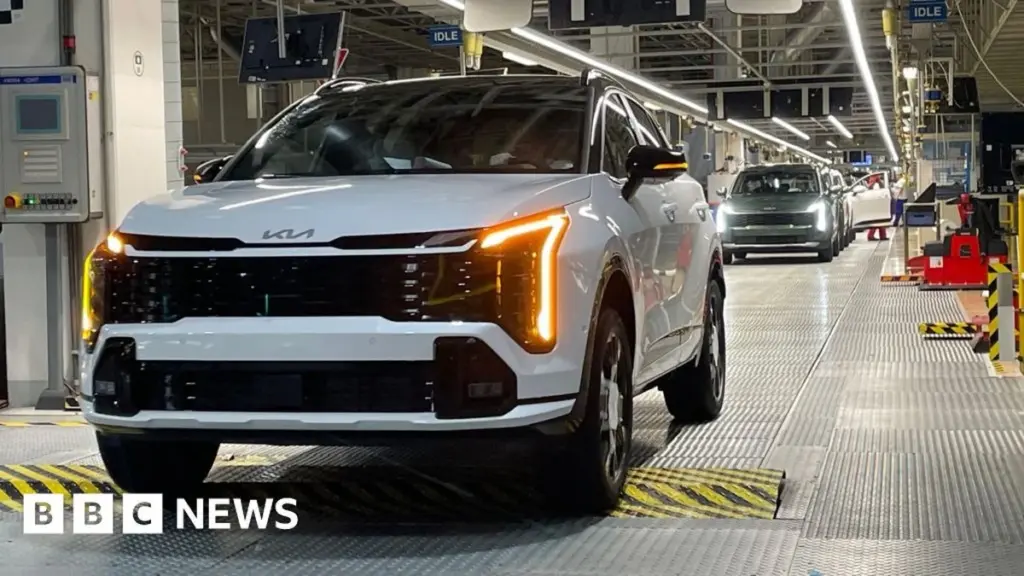
Within the imposing industrial expanse of a Slovakian factory, with snow-capped mountains forming a dramatic backdrop, steel car bodies descend from a sophisticated lift. These frames, meticulously assembled and welded by a workforce of 690 robots, are poised to embark on their transformation into finished vehicles. The subsequent stage involves a dedicated team of human workers, clad in distinctive red trousers and white t-shirts, who meticulously shape these raw metal shells. The relentless rhythm of this advanced manufacturing process is underscored by the emergence of a completed car from the end of the assembly line every single minute, its headlights flashing a signal of its readiness.
This particular facility is the European manufacturing hub for the South Korean automotive giant, Kia. Nestled near the northern Slovakian city of Žilina, the plant represents a substantial commitment from Kia, a project valued at €2.5 billion ($2.9 billion; £2.2 billion). Kia is not alone in recognizing Slovakia’s potential. The country also hosts production facilities for Volkswagen, Stellantis—a conglomerate that encompasses former brands like Peugeot-Citroën, Fiat, and Chrysler—and Jaguar Land Rover. Looking ahead, Volvo has announced its intention to establish an electric vehicle factory in Slovakia by 2027, further cementing the nation’s role in the automotive landscape.
Slovakia, with a population of approximately 5.4 million, currently produces close to one million cars annually. While this figure might appear modest when compared to global automotive powerhouses such as China, which manufactures an astounding 31 million vehicles each year, Slovakia holds a distinct advantage. The nation stands as the world’s foremost car producer on a per capita basis, a measure that accounts for its relatively smaller population.
The Human Element in Automotive Manufacturing
For individuals like 48-year-old Marcel Púchons, an assembly line worker at the Kia plant, the automotive industry represents a lifelong passion. “From a child, cars are my passion,” he shared. “Now I am part of the team, and I can make the cars, so that’s something that’s a dream job.” Marcel’s journey to this role involved living in Northern Ireland and England before returning to his native Slovakia to join the Kia workforce. His dedication is emblematic of the skilled labor force that underpins the country’s manufacturing success.
At the door insulation station on the assembly line, 23-year-old Simona Krnová offered her perspective. After studying business, she transitioned into the automotive sector. While she acknowledged this was not her ultimate career aspiration, she highlighted the positive aspects of her employment. “Half of my family works here, so I wanted to try. I like the people,” she stated. Her salary of €1,300 per month is considered competitive within the local market, with Kia reporting an average monthly wage at the facility of €2,400. This figure significantly surpasses the national average monthly salary across all economic sectors, which was €1,403 in 2023 according to official data, though it remains lower than the EU-wide average of €3,417.
Simona expressed a sense of national pride stemming from Slovakia’s prominent position in car manufacturing. “I like the fact that thanks to that, the production here supports our society,” she remarked. The workforce at the Kia plant is overwhelmingly Slovakian. The Korean presence is primarily confined to a few dozen senior managers who reside in a purpose-built, gated community located on the outskirts of a nearby village.
A Transformation from the Communist Era
The automotive landscape in Slovakia has undergone a dramatic evolution. During its tenure as part of the Czechoslovak Socialist Republic, the vehicles produced were, by contemporary Western standards, of notably inferior quality—characterized by noise, inefficiency, and poor performance. However, the Velvet Revolution in 1989 ushered in an era of profound change. Volkswagen’s investment in the Czechoslovak car manufacturer Skoda in 1991 marked a turning point, culminating in Volkswagen’s full acquisition of the company by 2000.
Following the peaceful separation of Czechoslovakia into the Czech Republic and Slovakia in 1993, other international automotive manufacturers began to invest in the newly sovereign nations. Petr Prokop, an expert in the automotive industry and head of Give Management Consulting, a business advisory firm based in Munich, pointed to the historical economic advantages Slovakia offered. He noted that labor costs in Slovakia at the time were a mere 20% of those in Germany. Prokop further elaborated that Slovakia continues to maintain a significant cost advantage, with wages approximating 60% of Western European levels, combined with high levels of productivity, making it a highly competitive manufacturing location.
Strategic Advantages in the Automotive Sector
Further along the Kia assembly line, a sophisticated machine dedicated to installing air conditioning systems signals its positioning with a snippet of Mozart, a melodic alert to clear the path. Many of the vehicles being produced are equipped with right-hand drive steering wheels, catering to markets like the United Kingdom. Indeed, the United Kingdom represents the largest export market for the cars manufactured at this plant, with Kia establishing itself as the fourth best-selling automotive brand in the UK. Other significant European markets for Kia vehicles include Spain, Italy, and Germany.
Marc Hedrich, the outgoing chief executive of Kia Europe, emphasized the strategic benefits conferred by Slovakia’s central geographical position within the continent. “Slovakia is really in the heart of Europe, quite well-connected to the big markets,” he stated. The country’s robust high-carbon and renewable energy generation infrastructure, encompassing hydro and nuclear power, also enhances the appeal of its electric vehicles. This favorable energy mix facilitates eligibility for substantial government purchase incentives in various markets, such as the UK’s Electric Car Grant scheme.
Another critical asset for Slovakia’s automotive industry is its extensive network of component suppliers. With approximately 360 companies actively serving the automotive sector, the depth of the supplier base is substantial. “The supplier base is enormous,” Mr. Hedrich commented, underscoring its crucial importance. While Kia declined to provide specific details regarding incentives received from the Slovak government for establishing its operations in 2006, Hedrich did confirm a tax credit of €29 million received for the modernization of its Slovak production lines for new electric vehicles, an initiative that cost a total of €108 million.
Government Incentives and Regional Impact
The Slovak government actively provides incentives to automotive manufacturers, recognizing the profound economic benefits these investments bring to the nation. Peter Fiabane, the mayor of Žilina, highlighted the substantial impact on employment and regional economic vitality. “There has been a huge decline in unemployment, and a significant increase in the economic strength of the Zilina region thanks to Kia,” he observed. He further noted that “Today, more than 20,000 people are directly employed by Kia and other companies that are linked to Kia by production.”
Hedrich also pointed to the high caliber of the available workforce in Slovakia. The Zilina Technical School offers a Kia-sponsored “dual program,” integrating theoretical study with practical work experience at the factory. Annually, around 400 graduates from the nearby University of Žilina secure employment within the automotive industry.
Eastern Europe’s Growing Automotive Footprint
Slovakia’s success story is mirrored in other former Eastern Bloc nations, which have also attracted significant investment from Western and Asian carmakers. The Czech Republic hosts factories for Hyundai, Toyota, and Volkswagen. Poland is home to production sites for Toyota, Stellantis, and Volkswagen again. In Hungary, Audi, Mercedes-Benz, and Suzuki operate facilities. Romania benefits from production by Ford and Renault, while Serbia also features a Ford plant. These countries share common attractions for automakers: competitive labor costs, a strong industrial heritage, and a well-educated workforce.