
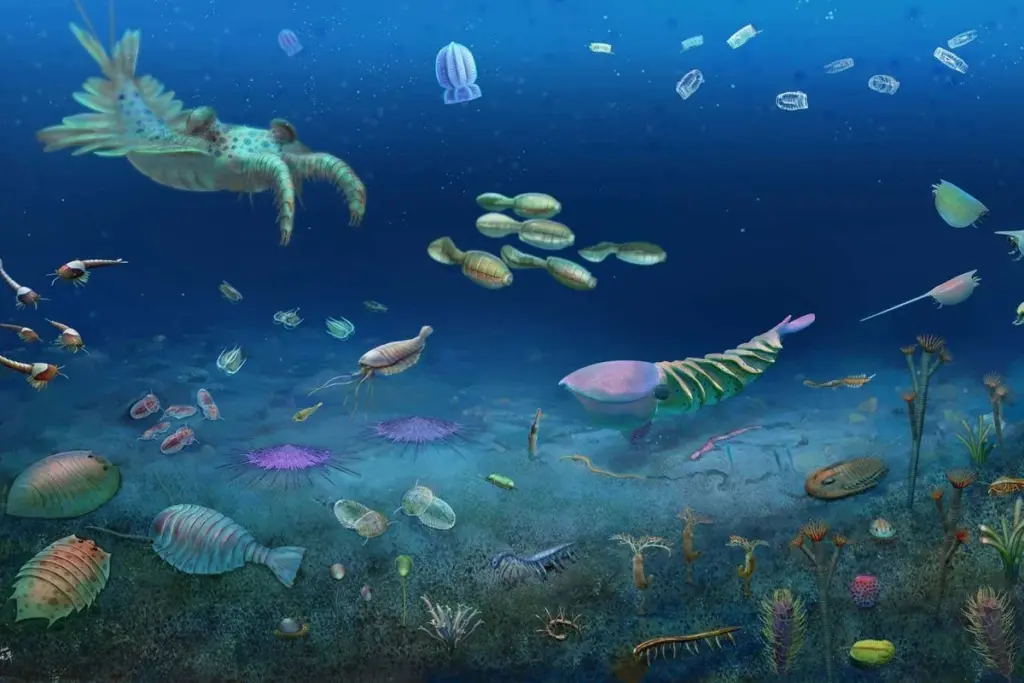
A remarkable fossil site, dating back 512 million years, has been unearthed in southern China. It offers an exceptionally detailed glimpse into an almost complete ecosystem from a period shortly after Earth’s first major mass extinction event.
These fossils originate from the Cambrian period, which commenced 541 million years ago. The early Cambrian was characterized by a dramatic surge in animal life’s diversity, leading to the emergence of most major animal groups extant today.
However, this period of flourishing was disrupted by the Sinsk event, occurring around 513.5 million years ago. This event led to a significant decline in oceanic oxygen levels, consequently causing the extinction of several animal groups.
Discovery and Initial Analysis
The discovery was made in 2021 by Han Zeng, affiliated with the Nanjing Institute of Geology and Palaeontology in China, and his colleagues. They found the fossils at a quarry located in the mountainous Huayuan County of Hunan Province.
To date, the team has analyzed 8,681 fossils representing 153 species. Notably, nearly 60 percent of these species are new to scientific understanding. The researchers have named this ancient ecosystem the Huayuan biota. They assert that the site’s significance rivals, and potentially surpasses, that of the highly acclaimed Burgess Shale in Canada, another prominent Cambrian fossil location.
Composition and Environmental Resilience
The Huayuan biota comprises 16 major animal groups believed to have inhabited the deep ocean. These groups appear to have been less affected by the Sinsk extinction event.
“Our prior understanding of the Sinsk extinction event was solely derived from the fossil record of animals with skeletal structures, such as archaeocyathid sponge reefs, trilobites, and small shelly fossils,” explained Zeng. This new find provides a broader perspective.
The Huayuan biota also includes a significant number of soft-bodied animal species. Zeng elaborated, “We observed that the extinction primarily impacted the shallow-water environments. The deep-water environment at the edge of the continental shelf, where the Huayuan biota is located, experienced far less disturbance.”
Dominant Life Forms and Ancient Connections
Arthropods, distantly related to modern insects, spiders, and crustaceans, constitute the majority of the unearthed fossils. The assemblage also features mollusks, brachiopods (shelled creatures), and cnidarians, which are relatives of jellyfish.
The largest organism recovered from the quarry is an arthropod named Guanshancaris kunmingensis, measuring 80 centimeters in length. This creature would have occupied the apex predator role within the Huayuan ecosystem.
Another significant arthropod discovered is Helmetia. This genus, along with one other, was previously known only from Canada’s Burgess Shale. Its presence in Huayuan, situated “halfway across the world,” according to Zeng, indicates that early animals possessed the capability for extensive long-distance dispersal. This mobility was likely facilitated by the transport of animal larvae via ocean currents.
Exceptional Preservation and Scientific Significance
Zeng attributes the exquisite preservation of the fossils to the rapid burial of the animals under a fine mud slurry. The details captured are extraordinary, preserving not only skeletal structures but also soft tissues. This includes articulated appendages like walking legs and antennae, feeding structures such as pharynx and guts in many specimens, and even delicate elements like gills, respiratory organs, and neural tissues, along with eyes.
Joe Moysiuk of the Manitoba Museum in Canada commented that the combination of species diversity and preservation quality “vaults Huayuan into the top tier of Cambrian fossil sites.”
While it is known that the Sinsk event caused substantial reductions in certain sponge and trilobite groups, information regarding its impact on most other animal lineages remains limited. “Discoveries like the Huayuan biota provide us with critical snapshots of this soft-bodied biodiversity during the Cambrian, filling in missing frames in the proverbial tape of Earth’s history,” Moysiuk stated.
Comparative Paleontology and Future Questions
Tetsuto Miyashita from the Canadian Museum of Nature in Ottawa noted that the two most renowned Cambrian fossil sites historically are the Chengjiang biota in China (520 million years old) and the Burgess Shale in Canada (508 million years old).
“However, it’s akin to comparing Bach’s court ensemble with the Beatles; we need to understand the origins of their differences before discerning the overarching narrative they present,” Miyashita explained. “A new biota like this is vital because it assists paleontologists in dissecting the influences of geography, mass extinctions, and variations in ocean depth and chemistry.”
A notable absence within the Huayuan collection is a specific group: “Where are the fish?” Miyashita posed the question. “Were they experiencing a global decline and were exceptionally rare, or was there another ecological factor preventing them from preying on the numerous soft-bodied species found here?”
Zeng indicated that his team has not yet completed the examination of all collected fossils. “New species will undoubtedly emerge. Fish might be present, and we will await further analysis,” he concluded.